What is “On Our Radar”?
This page is our look into SMTD’s future. The projects underway, projects soon to be started, and service items we get asked about all the time. This is where you find out all there is to know about what’s going on right now and in the near future.
Last update: January 8, 2026.
With an indoor public waiting area and an outdoor public plaza with multi-level seating at the SMTD Transfer Center, the Springfield Sangamon County Transportation Center is well underway.
Completion of the entire project including the 9th Street side and Amtrak Station is expected in 2027. The images below show the indoor passenger waiting area including device charging stations and interactive information kiosks.
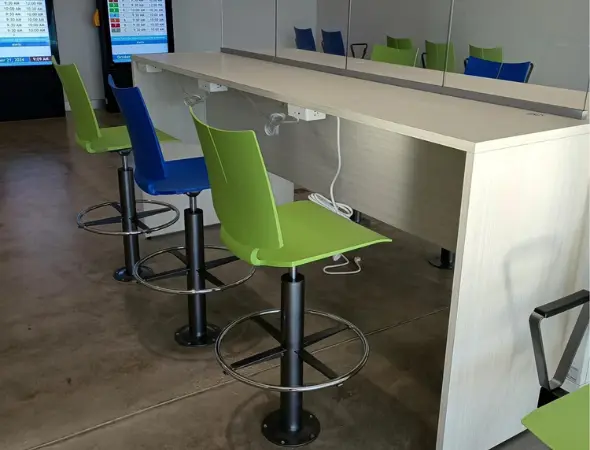 Indoor Waiting Area
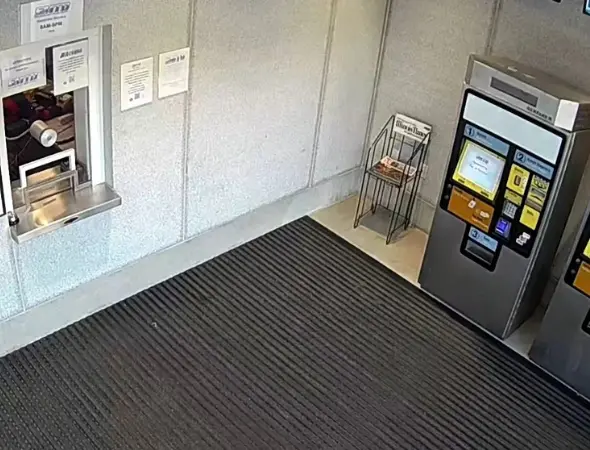 Ticket Vestibule
Ticket Vending Machines Available
Ticket vending machines are now available on-site at the transfer center as well as sales through LIVE customer service representatives at the facility.
As these newer fare options and fare data are evaluated, we will consider the need in the months ahead for making Open Payment options using debit and credit cards directly at the fare box or any other options that might make the customer service experience as seamless as possible. Any such change would require significant funding and procurement. So the process would take some time.
Improved Safety
The safety of our passengers and our employees is important to us. That’s why, when the Sheriff’s Office needed to re-evaluate our security agreement due to personnel shortages, SMTD reached out to other local law enforcement to quickly adjust. Currently, off-duty, sworn police officers provide security at the transfer center, and we look forward to continued discussions with local law enforcement as the HUB is completely constructed and security is put in place to fully cover the facility on both sides of the railroad tracks sometime in 2027.
Secondary Transfer Hub
In January 2024, Governor J.B. Pritzker announced the latest round of state funding for transit infrastructure, including $6.7 million for the construction of a new SMTD secondary hub in the area of the current Junction Circle Transfer Point.
SMTD is working on acquiring property for this project. While the design phase has not yet begun, SMTD anticipates a facility with 10-12 bus bays, indoor breakroom and restroom facilities for bus operators, and some type of covered, outdoor shelter for passengers. More information will be made public as the project progresses.
New Hybrids Enter Service! More to come!
SMTD has been awarded federal low/no emissions funding for an additional nineteen buses (8 hybrid; 11 CNG) to replace our 2013s and 2014s. This replacement batch will raise our low-emission count to over 80% of our fleet. We are also currently studying other alternative fuel options, although any implementation of zero emission buses would not likely occur until at least the 2030s.
Route System & Service Study
The completion of the Springfield Rail Improvement Project, which would move rail service from the 3rd Street rail corridor to the 11th Street corridor, is scheduled to be completed in late 2027. This timing is ideal for the implementation of a new and improved route system to follow.
SMTD plans to use this opportunity to re-evaluate the current system, look for service gaps to underserved areas, bus stop infrastructure improvements, and address any related issues.
An external firm specializing in these types of comprehensive operational analyses will be brought in to conduct the study, and SMTD will use the results to guide changes to routes and service.
In area communities outside of our district boundary, initial urbanized area fixed route service was implemented a few years ago, and ridership did not support the amount of personnel required to man the service. It was subsequently suspended. In order to serve “holes” in our service within the taxing district and also out into our urbanized areas, SMTD is exploring “microtransit”. Microtransit is a mode new to the transit industry in the last few years in which passengers can be picked up at designated microtransit stops and taken to a nearby connection point in the fixed route service. That could be a major hub or a transfer point where several buses meet out on their routes.
We anticipate this will be studied in the larger operational analysis and be considered as a possible solution to address underserved outlying areas if demand for such service exists.
Website Overhaul
This website has grown from a small, early staff-created and staff-run Squarespace site to the large collection of information it is today - still on that same platform.
SMTD and LRS Web Solutions have built a new website that is easier to navigate, easier to connect to important tasks like buying fare and planning trips, and easier to find important information about service changes, detours, and other important documents
Our “To Do” List
We receive many requests for service changes each week. Some are specific to a stop, and others are more reaching like a new route to a certain area or new service when service isn’t currently offered.
Here is our “To Do” list of items we know the public would like to have, and some explanations as to when and how soon to expect them or why certain types of service are more difficult for SMTD to add.
Wi-Fi on Buses
In an effort to accommodate passengers who may not have a substantial data plan - or any plan at all - on their mobile device, SMTD plans to implement WiFi on buses. The cost and process for implementing this technology are being explored, and, in an effort to assist all passengers in accessing fare, schedule, and other future SMTD offerings like mobile pay, we look to implement this new technology in the next year or two. When we do, we plan to offer multiple training events to assist all passengers wanting to learn how to better utilize features on their individual devices/phones.
More, Easy-to-Use Tutorials
Following up on the training events mentioned previously, SMTD plans to produce and offer more user-friendly video tutorials, walking current and prospective passengers a visual demonstration of how to use SMTD’s services. Let us know through our customer service email if there are certain processes or items you would like to see covered in one of these video tutorials. Scroll down and fill out the form that will be submitted via email to our staff.
New, Better Night Service Routes
Upgrading SMTD night service is on our short list of planning projects. The four large loop routes were difficult to use and were limited in coverage.
UPDATE: 2024 saw one west side loop route split into two bi-directional night routes, and one north side loop route replaced by extending three popular daytime routes, 2, 3, and 5, to run hourly during night service. By the time we finish this year with the east/south side routes, we will have more than doubled the number of night service routes available, and they are universally more useful as bi-directional routes.
We expect the final east side and south side night service route changes to go into effect in the Summer or Fall 2026.
Better Weekday Service
Over two years ago, SMTD implemented the first complete route system re-design in our 50-year history.
After over a year of data-gathering and feedback -- even with the drop in ridership due to COVID-19 -- we have been able to identify some issues in the new system we would like to address.
Travel from one corner of the city to another could be improved, and more direct service in some areas is desirable.
Along with a few low-performing routes and new, improved roads in certain areas, we will look to make improvements as soon as we can do so with adequate headcount, fleet size, and time to properly plan and test new service.
We hope we can start the planning process this year, but any major route changes are not likely until a larger re-design would go into effect after the 3rd Street rail relocation in 2027.
Saturday Night Service & Sunday Service
A desire for Saturday night and Sunday service has been expressed by some members of our community. However, while funding of such a service would be substantial, the bigger challenge would be finding enough bus operators to sustain such an increase in service.
Since the pandemic, SMTD struggles to maintain headcount to support our current fixed route and paratransit services. A cost/benefit analysis and taking into account the hiring factor does not get us to adding these two particular services in the near future.
To do so would likely require reducing frequency during weekday service from 30-minute service to 60-minute service, which we believe would be more detrimental to the community than the current limited weekend service. That said, the comprehensive operational analysis outlined previously would likely look at weekend service as a part of the entire system.
Bus Shelter Improvements
- Upgrading shelters - We will plan to replace existing shelters in high-traffic areas with new and improved shelters and consider adding amenities like route and schedule information and solar lighting. This process is included in our five-year-plan but is probably at least a couple of years away.
- Report A Stop - With over 1,200 bus stops in our system and a small staff to maintain them, crowd-sourcing issues at bus stops may result in faster repairs and improvements. SMTD now has a website feature that allows passengers or anyone in the general public to report an issue with a particular bus stop: Report a Bus Stop Issue!
What Slows Us Down
As some reasons were mentioned before, it’s important to understand what drives and limits SMTD’s ability to provide more service. Four major components limit what we will be able to offer in the future or how long implementation might take:
Headcount
The number of employees available for any given purpose is referred to as headcount. Headcount can be affected by many factors from competition with other employers to strict drug and alcohol policies to illness and retirements. Even with a larger fleet, it still takes operators to drive the buses.
In 2019, SMTD’s significant route system re-design, along with night service additions in recent years, ultimately added considerable service hours without fully corresponding headcount increases.
SMTD is currently working to attain our desired headcount in operations, and we hope we can overcome this limitation very soon.
UPDATE: We have added buses and bus operators to our paratransit department, which has experienced the fastest-growing ridership in recent years. We hope to attain full headcount in fixed route service soon in the hopes of expanding service there as well.
Fleet Size
Every route takes a number of buses. For instance, an hour-long route that runs every thirty minutes requires two buses.
Currently, SMTD has no spare ratio or contingency fleet other than what is generally in the garage for regular or preventative maintenance. That means we’re currently unable to add weekday service because our fleet is being utilized to its maximum capacity.
As we attain a “state of good repair” with our current fleet, we are already planning to expand the fleet with one of our next purchases of new buses.
Hopefully, the condition of our fleet will allow us to further expand rather than having to replace buses far past their suggested life.
Local Match
When SMTD applies for funding from state or federal sources, nearly all available grants require a “local match”, which is funding SMTD provides from local property taxes and other sources of revenue like fare collection and advertising sales.
Since our boundaries have not changed since our founding in 1968, our tax base has grown only as far as those old boundaries have allowed. So, while our local levy is a stable funding source, the amount of leverage we can attain with 20% (federal) and 80% (state) required match remains limited.
SMTD is proud of the financial stability we have sustained, and we always plan for sustained service over time rather than risk future service cuts for the latest trend or popular service offered in much larger transit districts like Chicago and St. Louis.
As technology and additional facilities add substantially to our operating costs, we must also be mindful we maintain financial sustainability well into the future.
Our Size
SMTD is often accused of using our size as an excuse for poor service. That’s simply not true, but our size does play a role in how quickly we can make major changes happen.
Our entire administration department is smaller than many individual departments at larger transit agencies. For instance, while a larger agency might have a Grants and Procurement Department that has multiple staff members looking for grant opportunities or a Planning Department constantly analyzing data and planning service improvements, SMTD usually has one person dedicated to a particular subject matter and sometimes multiple areas. So, even with excellent multi-tasking employees, major changes just take longer to plan and implement at a smaller transit agency of our size.
SMTD has worked hard to evaluate staff needs and make additions where possible and will continue to do so as we make advances in technology, service, and facilities.